|
|
ARTCLASS
A FOCAL POINT - WHAT IS IT AND DO I REALLY NEED ONE?
This article is one long page, designed to be printed easily.
Many excellent pictures have been created by artists who have not bothered with a focal point at all. Instead, these pictures tended to be "about" pattern and texture, a tapestry of shapes and colours. Nevertheless, I believe it is fair to say that a picture will always benefit from having one strong "focal point" - an expression which means, quite simply, the centre of interest. A good way to think about the idea of a focal point is to create, in your mind, the image of a stage full of dancers. The lights are set to wide beam, to take in the whole stage. Your eye darts from dancer to dancer, finding it difficult to concentrate on any one spot on the stage. Now imagine the lights dimming, and a brilliant spotlight shooting out to illuminate one dancer. Now you have no problem where to look; you are being directed to look at just one spot, while your peripheral vision takes in the rest of the scene.
If you simply sit down to paint whatever is in front of you, without planning the composition and creating a focal point, you run the risk of producing a rather weak picture, one without a clear sense of purpose. Perhaps the subject doesn't have an obvious focal point - in which case, you may need to create one. A seascape, for instance, may have no obvious focal point, and in fact the sheer scale of an area of ocean makes it difficult to focus on one spot, but the fact remains that for the picture to be interesting, the viewer's eye needs to be held within the rectangle, focusing on one dominant area to begin with, before moving on to examine the rest of the image.
How to select a focal point
Ask yourself, when you sit down to paint, what it is that first attracted you to the scene. It may even help to write down a few words in your sketchbook. If you liked the whole scene, then ask yourself what you would best like to emphasise, or draw particular attention to. sorting out your thoughts before you paint is an important part of the process of painting. It doesn't mean that these ideas and thoughts are set in stone; you might decide to change the emphasis during the course of painting - but it definitely helps your confidence, and sense of direction, to have a good, positive starting point. Deciding on what is most important in your picture will give your picture meaning and your reason for choosing that particular scene will be clear to the viewer.
How to position your focal point.
You should, ideally, aim to direct the viewer's eye into and around the picture. Therefore, then, the placing of the main elements of the picture is rather crucial, isn't it. Artists throughout the centuries have depended on a system called "The Golden Section", a way of dividing the rectangle which is quite complicated, but worth exploring. I won't go into it here - no space - so let me tell you the rule I use. "A third of the way in from one side and a third of the way down from the top (or up from the bottom). This "rule of thirds", as I call it, is a good simplification. Don't put important elements - and certainly not your focal point - at the edge of the picture. It will look like it is trying to escape!
Also, although having one, main, focal point is ideal, it is perfectly reasonable to position other, less important "secondary" focal points around the picture.
Emphasising the Focal Point
Sometimes your focal point will fail to attract attention. There are several devices you can use to ensure that the focal point commands the viewer's attention properly.
1. STRONG CONTRASTS OF TONE
If you place your lightest light area in the picture next to your darkest dark area, this will command attention since it will be an area of great visual tension and drama.
2. STRONG CONTRASTS OF COLOUR
By placing vivid "complementary colours" next to each other (blue next to orange, red next to green or yellow next to purple) you will draw the viewer's eye to this point in the picture. If you use colour contrasts to draw attention to a focal point, the colours you use must be in key with the rest of the picture so that they don't jump out in isolation, and should be gently echoed in other areas.
3. DOMINANT SHAPE
A main, large shape in the picture will command attention - but be sure to integrate this shape with the rest of the composition, by echoing the shape with less dominant but similar shapes elsewhere, and consider "softening" edges in places to knit the shape into the rest of the picture.
4. DIRECTING THE EYE WITH LEAD-INS
Directional lines, implied lines, and points within an image can be used to gently lead the viewer to the focal point. For example, a pathway might lead up to a group of figures; the light-touched tops of clouds might bring the eye down from the top of the picture to an important tree in the middle distance. In a still life, the edge of a table, or frame of a picture on the wall in the background might direct the eye to the bowls and jugs on the table. Becoming aware of shapes, and edges, within a rectangle, instead of thinking solely about the physicality of the objects in the scene, is a big mental step to take, but a vital one to encourage the development of your sense of design.
5. USING A VIEWFINDER
You will find it really helpful to use a viewfinder. We tend to "see" our subjects, particularly landscape subjects, landscape shape. Yet a tall focal point may be much better expressed in portrait format. Make thumbnail sketches of the view. Feel free to adjust elements within the scene, to emphasise of echo the focal point - you could shorten a tree, for instance, if it is exactly the same size as the church, your focal point.
In conclusion - well, almost
Taking a subject such as "the focal point" and examining it in isolation is a little dangerous, since it means that we can forget that the focal point may be dependant upon, and modified by, other factors. So although I have offered you a few basic ideas about the focal point in relation to the composition of a picture, please be aware that it is only a small, if important, part of the whole.
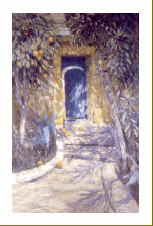
Moroccan Doorway, Pastel on paper. The viewer's eye is directed to the focal point - the doorway -by the lines of the pathway. The doorway is a large, dominant rectangle, echoing the shape of the entire rectangle. We follow the light curve of the path from the left side of the rectangle to the door, and over the top of the light, curving shape within the dark recess, before examining the rest of the picture. Notice, indicentally, that the edges of the pathway are not symmetrically placed. Positioning them at the same point to the left and to the right, would have been very boring!
Thank you for taking the time to read this article. If you enjoyed it, and would like to see more of my work and read about my books and videos, please CLICK HERE.